A letter to my friend,

Every year in June, teachers say farewell to students for another year, schools say farewell to students graduating/articulating, and adults say farewell to colleagues and friends. Retiring from education is a celebration.  I have attended many retirement celebrations through the years for so many powerful educators that dutifully served education for 20/30/40 years.

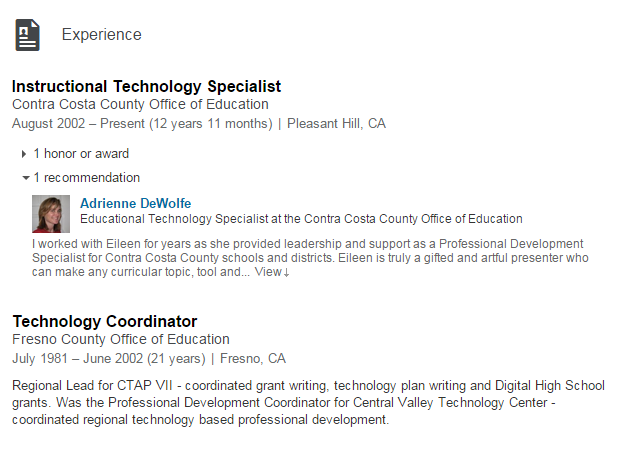
In June of 2015, my friend and one of my mentors bids farewell to a commitment to education like none other.  She is small in stature, and a hero at that size!  Eileen Walters is retiring from her role as the Instructional Technology Specialist at Contra Costa County Office of Education after 12 years.  She embodies all the characteristics that are the very best of every teacher: grit, curiosity, hope, and a dedication to professional growth.  She doesn’t get a lot of the spotlight. She is behind the scenes often, making magic happen supporting others.

On the topic of support, Eileen did this for me.  In 2003, I was a new Administrator in my Educational Technology Coordinator role.  She spent countless time getting me up to speed on initiatives, gaining my understanding of complex systems, and pushed me for excellence in my work.  She doesn’t like recognition, prefers to plug away.  I won’t let her go that easy.

Eileen stays with me setting the tone as I embark on projects, train teachers, and push limits.  Eileen reminds me to expect excellence in others, set guidelines, check their work.  From my time working closely with her for 9+ years on a regular basis, calling her every time I hit a crossroads, and bugging her often for support; I am a better professional. Thank You now, often, and always.

Here’s Eileen’s professional background:

LinkedIn profile
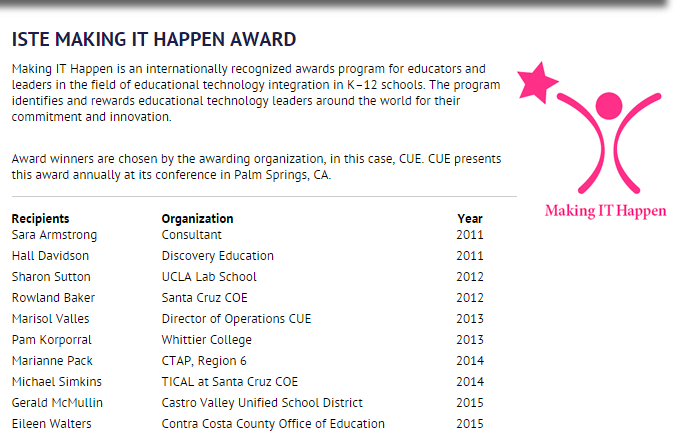
Her newest project- (She has had many too) is the Leading Edge Certification for the Professional Learning Leader is being developed under the leadership of the Certification Chair, Eileen C. Walters.

Leading Edge

This tells me we can work together again.  For this, I am very grateful.

Backseat Driver: Changes far from the classroom

Can changes made far from the classroom in a district impact the classroom? Can a student feel the difference when you make changes to operations that only impact the adults in the room?

I hope so and believe so. As a school administrator, I believe the work we do at the district level does impact students.

How? If we can make the day-to-day life of teachers and staff more manageable by improving their more mundane tasks (e.g payroll reporting, attendance-taking) it will be one less stressor for them. My hope is that relieving teachers and staff of these kinds of concerns will improve their everyday experience. Happier teachers=happier students. I will argue if all staff supporting teachers approach their work this way, kids win. Small incremental change can be as powerful as large-scale overhaul efforts.

PBL: Then and Now

IMG_0416Back in the late 1990s, I had the opportunity to serve as an associate director at a brand new multimedia college in Emeryville, California. I was hired before the building was finished and was given the task of creating a program that would be delivered in three parts to college students: Living in a Media World 1, 2 and 3. Parts one and two focused on the (relatively) new concept of the World Wide Web. I had to hire a staff, set up a Mac lab, and write a curriculum and lesson plans that would be delivered over the course of the first two months to a cohort.

I was a recent graduate of a Master’s program, and in that program we completed many projects as a cohort. My own experience became a model for the program I designed and delivered for two years to a minimum of six cohorts with a team of four staff.

The first courses were embedded with website design projects. With college students, projects are an efficient way to show skills and mastery of concepts in a multimedia environment. Assessments and essays are not as appropriate for that population. Fast-forward to 2015 and the new hot topic is called Project-Based Learning.

When I have conversations with teachers who have taught more than 10 years, their teaching back in the 1970s-1980’s was very much like my teaching at the college level in the late 1990’s – looking back, both would be considered Project Based Learning. So here’s the bad news: PBL is not new, but the good news is that many of us have done it and it works.

Want to learn more? This Project Based Learning page from Edutopia is a great resource – with an overview, research, and more.

If it doesn’t challenge you, it doesn’t change you

id-10078218I’ve been reading articles on low teacher morale in regards to Common Core, and if I were to internalize all the negative feedback, feelings, and opinions on this topic, I’d be really discouraged. Teachers across many states have already decided Common Core isn’t working. I don’t know how we can decide something doesn’t work when it hasn’t been fully implemented. I’m puzzled by the idea that national standards that help us make sure we are meeting the needs of our students are problematic. How can ensuring our students are college and career ready by following a technology-driven pedagogy be ineffective? I believe the bigger issue is a resistance to change. If that is truly the case, then the bigger question becomes how do we instill a spirit of change and flexibility in an industry (education) that is as old as our nation?

I read that some believe that the new exams (PAARC or SBAC) are “too hard.” Really? If we lower our expectations of students, will that become a self-fulfilling prophecy?

People say that we need to change education to better meet the needs of our students. Here’s my question to you: How can we improve our schools if every change we introduce is doomed to failure at the onset?

My answer to this question? I stay the course. Call me an optimist. Call me disconnected. I think change is good. It forces us to rethink our assumptions. It encourages us to take risks. So what if it doesn’t work and all of the naysayers are right? Then we teach our kids another important lesson-how to try, perhaps fail, and learn from it.

(quote attributed to Fred Devito/Image courtesy of mrpuen at FreeDigitalPhotos.net)

We are ALL Makers!

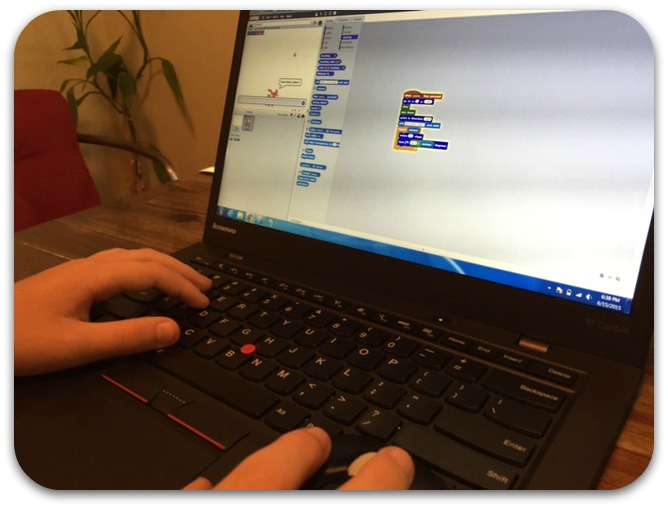
My family has been attending the Maker Faire for the last five years. We also attend the East Bay Mini Maker Faire every October in Oakland CA. At these events, we are exposed to amazing innovation and brain power-sometimes it’s simply breathtaking. These events have instilled some very important concepts into me and my family. We are makers. We are inventors. We are creators. Recently, I have begun to see the Maker Movement (as it is called) bleed into K-12 schools as teachers see the value for PBL and engagement. There are now magazines, books, kits, YouTube channels, and clubs spawning all over the US and beyond. My 9 year old belongs to a Curiosity Hacked guild where they build, create, and explore with a set curriculum and badges. We’re sitting in a Scratch class right now @TheMADE; another offshoot of Maker Movement. Makers are made daily as we get up off the couch and begin building again. As a mom, I’m good with that.

One great example of the power of this new movement is “Super Awesome” Sylvia Todd via Mindshift. She’s 13 and has created her own Project Book, hardware kits, and video series geared towards kids to help them dive into this exciting world. It is inspiring to see how this movement has hooked her and how she in turn is so passionate that she is now teaching us all. This is the power of the Maker Movement.

Teachers: Don’t be shy, dive in, step aside and let the kids run the show in this new realm. They will amaze you and teach you a thing or two. If you’re unsure where to start, ask Sylvia!

Small Changes

id-100202098I attended a medium-size high school in a medium sized city: Reno, Nevada. I attended and graduated from Sonoma State University, which is a medium sized state college and studied at smaller private college for my Masters in Management/Organizational Development. With a few rare exceptions, all of my jobs have been in medium sized organizations. Why does size matter? I believe as change agents we can make little changes that make a big impact–even in small-to-medium organizations. Completely retooling your instructional style is unrealistic in the course of a day, a week, a month, or school year, but attempting to introduce a even a slight change in your instructional style can have a significant impact on your students. Let’s say you use paper and pencil for most of your corrections on a document camera connected to the projector projecting onto your whiteboard. What if you tried using your tablet connected to the projector projecting onto the whiteboard? This would allow you movement in the room that you would not have otherwise. You could even get the bonus of handing off your tablet to a student to demonstrate a learning outcome. This is just one example of a little change that could eventually make a big difference in the student experience in your classroom. Give it a try and comment on this post with what you discover by making a little change. What’s the best “little change” you would share with a new teacher?

For parents of kids who *constantly* watch YouTube Minecraft videos: you are not alone!

san_diego_comic-con_2014_145970966991My nine-year-old spends every waking moment doing two things (when I let him):

  1. playing Minecraft on the server by himself, with friends, or playing games.
  2. watching YouTube videos about Minecraft.

I strongly encourage Minecraft as a hobby for all of the obvious reasons (Like this, this and this.) Someone sent me this resource from Common Sense Media (also a great overall media resource) on child appropriate YouTube videos for those little ones who spend every waking moment watching YouTube videos on Minecraft. I hope you find this resource useful-I plan on going home tonight and building a YouTube channel so my nine-year-old can watch only age-appropriate content. Let me know your thoughts, and any kid-friendly Minecraft channels your family likes.

Image by Deejay from SoCal, U.S.A. (SAN DIEGO COMIC-CON 2014) [CC BY-SA 2.0 (http://creativecommons.org/licenses/by-sa/2.0)%5D, via Wikimedia Commons

Diversifying the technology field

Coding is a hot topic on Twitter, LinkedIn, and just about everywhere in the media. But the tech industry currently is not well known for being a center of diversity in race or gender. Article after article, interviews, and blog posts are all discussing this issue: how do we change the current corporate culture in technology to more accurately represent our diverse nation? And especially, how do we empower our girls to help them onto a pathway to tech careers?

As a female who has been in the technology industry for approximately 17 years, I don’t have any answers. I do have all of the same questions as everybody else. How do we get girls involved in any industry that has been dominated by men? How do we reach girls in low-income neighborhoods and kids of color to even consider technology as a course?

So, rather offer my thoughts as to how we can do it, I want to pose a question. What do you think is a way to reach at-risk, low-income students of color, especially girls, to consider careers in technology?

Interested in obtaining lesson plans for MinecraftEDU from other teachers?

This resource will help you if you are ready for Minecraft EDU in your school or calssroom and lack the lesson plans. An excerpt from the Minexrafct Teachers group:
*Date/Time:* Tuesday, April 29, 2014, 9:00 PM ET / 6:00 PM PT

*Lesson Title:* Teaching Programming with Minecraft and ComputerCraftEdu
*Presenter:* Michael Harvey, Falmouth Elementary School

*Description: *This session showcases a Minecraft world that has been used
to teach programming and computer science concepts to elementary and middle
school students. Viewers and participants will get a sneak preview of the
highly anticipated ComputerCraftEdu mod, which adds programmable robots
(called turtles) and an icon-based programming environment that is
student-friendly and geared towards a transition to traditional text coding.

The world features hours of problem-solving activities for whole classes or
individual learners. This event will allow interested teachers to go
through the world as students, allowing them to see firsthand what the
lessons feel like. There will also be an opportunity for participants to
“fly” through the world, previewing additional lessons, discussing context
or classroom extensions.

*Participation Information:*
*In-Game Participation*

*Minecraft Version:* MinecraftEdu 1.6.4 build 14
*Mods Required:*
· ComputerCraft+ComputerCraftEdu1.63pr2
· CustomNPCs_1.6.2-1.6.4
*MinecraftEdu Server Address:* mine.temple.edu
*Mumble Address: *shoyu.craftx.biz